Research
Language models and agents
Agents that operate external software
A model that can call tools is only as useful as the surface it is given and the evidence that it uses that surface correctly. I build agents that drive external software: defining the tools the model can reach, assembling test data that represents the work the agent is supposed to do, and improving the agent against measured results rather than against how good the transcripts look.
Model behaviour under fine-tuning
Fine-tuning a model on narrow data can produce broad misbehaviour. Inoculation prompting is a proposed fix. You deliberately elicit the unwanted behaviour during training with an explicit prompt, and the model learns to attach the behaviour to that prompt rather than to itself. It works well enough that it is already used in production, but its failure modes had not been mapped.
At SPAR I worked on whether inoculated behaviour is really gone or merely hidden. It turns out to be partly hidden. Across several experimental settings we recovered the suppressed behaviour using prompts that were semantically or structurally close to the inoculation prompt, which we call leaky backdoors. Rephrasing the inoculation prompt during training makes the leakage worse. Pairing benign training data with anti-inoculation prompts suppresses it substantially.
The work was LoRA fine-tunes across systematically varied training data and prompt conditions, with the resulting models measured on behavioural eval suites.
Working report: Stress-testing inoculation prompting, with Tim Farrelly and Ishaan Panigrahi, mentored by Maxime Riché and Daniel Tan. A paper is in preparation.
Earlier, as a PIBBSS fellow in 2022, I worked with Tomáš Gavenčiak on quantifying the agency of computational systems using information theory.
Biophysics
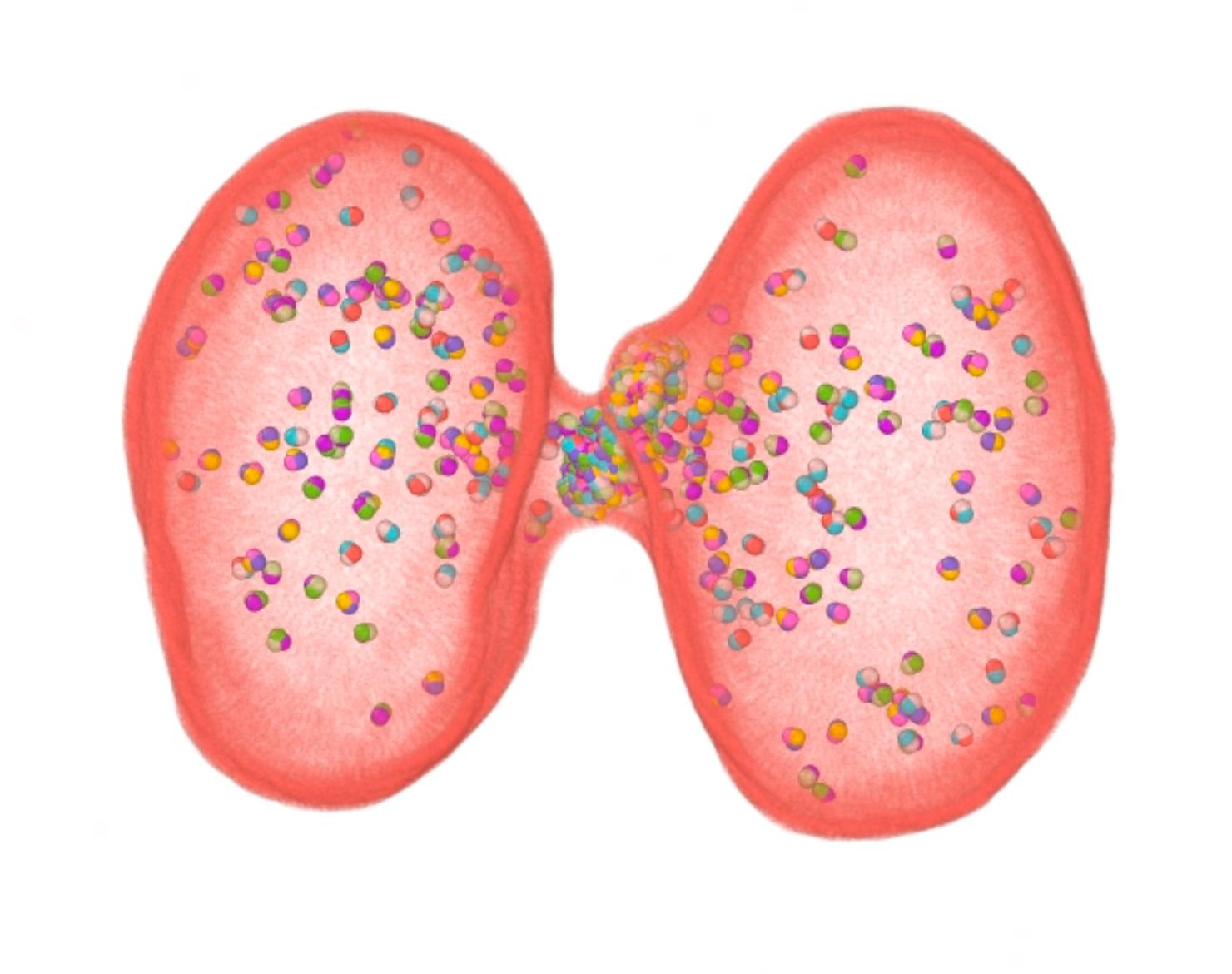
I have just finished my IST-BRIDGE postdoctoral fellowship, a part of Marie Curie-Sklodowska Action, in the group of Anđela Šarić at the Institute of Science and Technology Austria (ISTA).
The Šarić group uses coarse-grained modelling to understand a large variety of processes in biological cells, including protein aggregation, filament treadmilling, constriction of the actomyosin ring and microtubule growth in cell division. My project focuses on membrane remodelling and cell division via the action of elastic filament. These filaments represent proteins from the ESCRT-III family and their homologues, which are involved, e.g. in the division of Sulfolobus acidocaldarius or the scission of the eukaryotic cytokinetic bridge. To learn more about coarse-grained modelling of membranes, you can look at our review.1 An article about my work specifically will be published later this year.
Quantum chemical dynamics
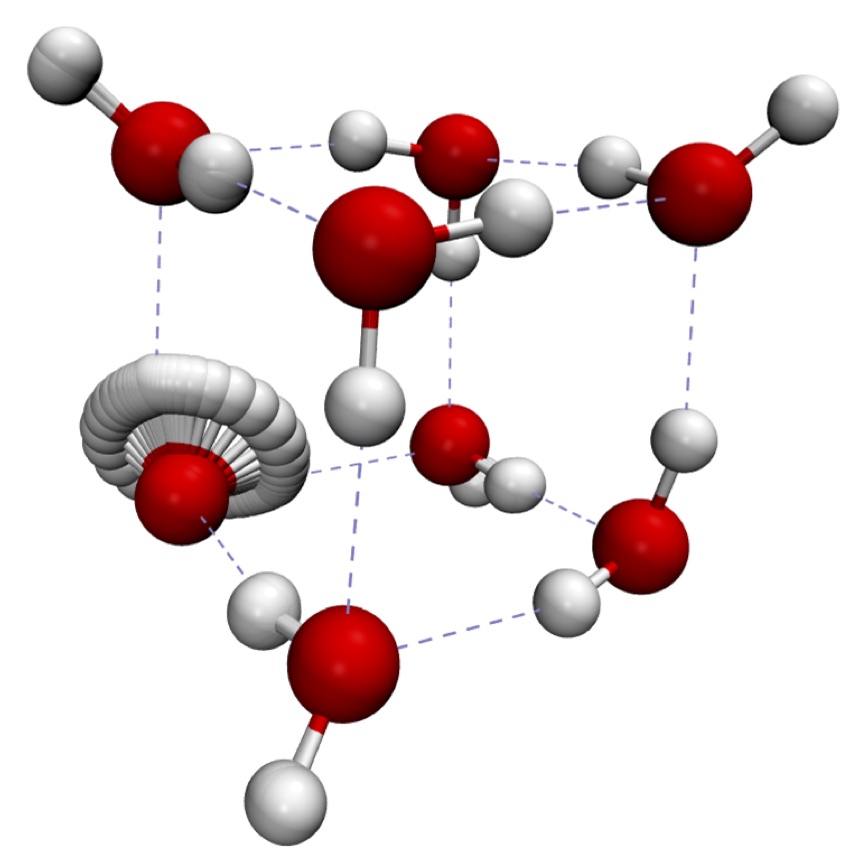
As a PhD Student in the Althorpe group at the Department of Chemistry, University of Cambridge, I carried out research in the field of quantum chemical dynamics — we investigate the motion of atomic nuclei.
The Althorpe group is a theoretical and a computational group interested in the development of new computational methods for chemical dynamics and physical theories underlying them. The most recent theory originating in our group is the theory of Matsubara dynamics, due to Hele, Willatt, Muolo and Althorpe.2 It combines exact quantum statistics with classical dynamics making it one of the best descriptions for calculation of quantum time correlation functions. However, the complex phase present in this theory makes it impractical as method, when implemented naively. Nevertheless, Matsubara dynamics is a rigorous theory underpinning most other path integral based chemical dynamics methods, like Ring Polymer Molecular Dynamics (RPMD) and Centroid Molecular Dynamics (CMD). It has already proved useful in the development of new practical methods with the recent introduction of Quasi-Centroid Molecular Dynamics (QCMD) by Trenins and Althorpe.3 For more information see our group website
In my PhD I focused on the chemical dynamics of systems attached to baths. Baths are used as simplified models of the environment of the calculated system. In the first year of my PhD I worked on the Hierarchical Equations of Motion (HEOM), which is a method that allows numerically exact time propagation of a system attached to a harmonic bath. Some of my results can be found in my first-year report. In the rest of my PhD I developed a novel way of simulating Matsubara dynamics of a system coupled to a harmonic bath. This not only allowed the inclusion of a vast number of the harmonic bath degrees of freedom, but also solved the complex phase problem for sufficiently damped systems. This allowed, among others, the very first Matsubara calculation involving non-linear position operators.4,5
-
Adam Prada, M. Muñoz-Basagoiti, F. Frey, B. Meadowcroft, M. Amaral, A. Šarić, Soft Matter, 2025, 21, 7736-7756, doi: 10.1039/D5SM00148J ↩
-
T. J. H. Hele, M. J. Willatt, A. Muolo and S. C. Althorpe, J. Chem. Phys., 2015, 142, 134103, doi: 10.1063/1.4916311 ↩
-
G. Trenins, M. J. Willatt and S. C. Althorpe, J. Chem. Phys., 2019, 151, 054109, doi: 10.1063/1.5100587 ↩
-
Adam Prada, Eszter S. Pós, Stuart C. Althorpe; J. Chem. Phys. 2023; 158 (11): 114106. doi: 10.1063/5.0138250 ↩
-
Adam Přáda, “Dissipative Matsubara Dynamics”, PhD Thesis, University of Cambridge, 2023, doi: 10.17863/CAM.95949 ↩